
We unlatched the gate, manoeuvred the pram through and found ourselves in a huge garden lined with linden lime trees with a carpet of tiny purple headed daisies, bushes of white and mauve lilac, the odd apple and pear tree dotted around. In front of us was a plain grey door in the middle of large wooden Hansel and Gretel house, with a round turret and balcony and we had the key!
On entry, we ran riot, upstairs, down, out on balconies, through sunrooms, boiler rooms, testing beds, chairs, and once we had allocated ourselves our bedrooms, we quickly unpacked and re-crossed the train track to the pretty little pizzeria with outside tables where pizzas named for each of the stations along the route were being cooked on the charcoal fire.

This is Jurmala, Latvia, the Soviet Rivière. The houses are amazing: quaint wooden turreted structures or three storied wood and glass palaces. Each has about an acre of garden or more cut into a glorious pine forest which marches along the train track with glorious beaches on the west side and a river and lagoons on the East.
It has a strange, almost ‘unreal’ quality and on local walks, we saw very few people. There were lots of Alsatians or Huskies guarding the gates. The first evening, at the pizzeria, large black 4x4s drew up, collected pizzas (delicious by the way) and drove away, wisely maybe because of the Baltic Breeze. We often had to wear all the clothes we had with us. I looked charming in blue ankle pants, white t shirt, blue and yellow plaid shirt, lime green cardigan, black socks and sandals.

The first morning, I got up early with Aine, and went out for a walk. I saw no one. Later, when everyone was up, we pushed the buggy down to the beach along the stony paths, through the trees, past the sanitorium which was built like a cruise ship. Once there, a few big bellied, men did their exercises on the beach. A stream of black figures marched purposefully along the shore singly or in twos with walking sticks. The grey flat, saltless sea rolled in and rolled back and there was a sense of a rhythmic routine to it. There were low uncomfortable benches and round concrete changing room structures were dotted along every 100 metres. A sign said this was an ‘activity area’ and we watched a circle of women from the sanitorium, following a supervisor, do hip exercises with their crutches. Roisin dipped into the sea for a quick swim and described it as ‘refreshing’. When I dipped my toe in, it was ‘freezing!’ Maybe this was why there was no one, other than the purposeful exercisers but, somehow this beach felt a little sinister. We waited for Roisin to avail of the changing areas which she said was a huge improvement on the towel. Maybe the summer season hadn’t started yet, I surmised, but the beach felt odd, utilitarian, I half expected a big round bubble to come out of the horizon, like it used to in The Prisoner series.

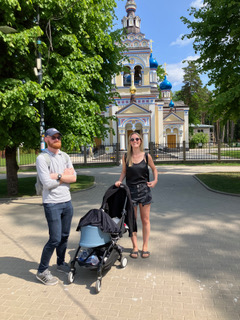
Our favourite place was Majori, is a lovely resort a few stops a long on the train. While the wind still whipped its way along the coast, our amble through the town was fascinating. On the main pedestrian strip, there were café and restaurants, a few jewellery shops, and only the odd clothes shop. At the end of the walk, was an ornate, shiny golden domed Russian Orthodox church beside which was a wonderful park with fabulous shrubs and tarzan walks. (I was on my crutch still so couldn’t avail). We walked to get tickets for the first open air concert of the season, but they were all gone, so we consoled ourselves with lunch in a lovely hotel and took a walk along the beach which was much more animated with cafes and people than our own utilitarian stretch.
During our few days, we visited different national parks, local towns and Riga, travelling a lot on the public transport system which was on time and extremely cheap. Joe did a brilliant job of navigation because you have to buy tickets on-line and twenty minutes before which with our indecisive party was no mean feat. All the trains had ticket collectors, one for every two carriages, and each took their job very seriously. As the tooting trains rolled into the platform, they seemed terrifying. With prams, and crutches, we had to clamber up six feet on tiny narrow steps to get into the carriage. However, with all hands on deck, we soon succeeded in managing a nifty entry process.

One of the days we went to Kemeri, a small town which has a national park. The wilderness was amazing, a meandering boardwalk across bogs, under tall trees, and across rivers. Unfortunately, it was lashing rain, so we got very wet. I could hear Jerry’s sandals slapping along behind me. We navigated our way into a town park which was beautifully laid out with formal avenues, ponds, statues, and follies but it was absolutely deserted and surrounded by formal, obviously once beautiful buildings, which were empty and desolate with no windows.

We wanted to get dry and some food. Google told us there was one pizzeria in the town which was in a small yellow plastic globe. We made our way towards it but when we got there, it was closed and surrounded by run down, shell like broken buildings, all with broken windows. It was really strange. We decided to get the bus home as the train wasn’t for an hour and a half. A few people were waiting at the bus stop, and they stared at us with interest. It was the first stop of the route, and by the time we got off, it was packed with workers going home. The women had dyed, sprayed hair, drawn on eyebrows, poor teeth. The men were older, in overalls, and generally had bad skin. We changed bus at a junction which was chaotic with lots going on: shops, markets, a circus. Everyone else was changing bus too and, for a moment, we were absorbed into the chattering melee of Latvian life. However, as we got closer and closer to our home stop, the talking ceased and the quiet had descended once again.
I enjoyed Riga. We went twice. The old city is lovely and on our last day we visited the museum of the Black Heads who were the local merchants. The building is extremely ornate and sadly was ruined during the world war. It was beautifully renovated in 1999. The museum did a good job of presenting the story of Latvia. In short, over the last hundred years, the country has been invaded by the Swedes, Germans, Russians, Soviets and God knows who else…the Prussians, maybe beforehand. I lost track. This might explain the demeanour of the Latvians which isn’t the friendliest. They seem to be a determined people who keep their head down and their path straight. However, they live in a beautiful country and I hope it remains not so badly contaminated by the bright lights of consumerism. I found the shops were practical and didn’t shout their wares with bright flashing neon lights. Of course, in Riga there were all the usual chains, but in the outlying areas the shops were small, dark, selling local produce, cheeses, sausages, wines. I guess the ‘unreal’ quality of the woods full of turreted houses and wooden and glass palaces is the usual wealth/poverty divide. Communism obviously didn’t eradicate that. But there is a ‘utilitarianism’ that we saw on the beach that, if its edges were filed down a little, is really practical. I plan to return, maybe when it is a little warmer.


 Kate Ennals