Thank You, World

2017 has been good to me, so far. My mother would say that by announcing this, I am putting its future in jeopardy! But to hell with caution, my yellow daffodil of spring wants to trumpet!

I have funding from Cavan Arts Office for a fourth series of AT The Edge this year, and not only that, we have nine brilliant readers (think cat and cream and you have the right image of me here). The first on Tuesday 2 May will see Cavan welcome Kate Dempsey, Colm Keegan and Helena Mulkerns. In August, Maurice Devitt, Stephen James (tbc) and Lisa Frank and in October, Afric McGlinchey, Mairead Donnellan, and Brian Kirk. I am so looking forward to seeing them all in Cavan.

So, I was surprised when another Cavan Arts Office envelope plopped down into the porch of The Bungalow last week – the porch is where I occasionally sit when my muse goes awol. I smoke, keep an eye on the neighbours, and watch for what my garden is growing. Anyway, this envelope from Cavan Arts Office was telling me that I had been given a professional development award to get a mentor to help me finalise my first novel and collection of short stories. This was brilliant news which came at a very good time for me as my muse has been more missing than musing recently. Not writing is another ‘art’ of writing that my mentor may have to help me with! In fact, in the past few months, I have spent more time submitting material (thanks to Angela Carr for her circulation of submission and competition deadlines) and editing my early stories. It has been alarming but interesting to see how raw and unkempt my early short stories are; a raggle taggle of cock tales in sore need of pickles and extra shots! I vaguely wonder, how I know this. When and how did I learn the craft? More to the point, what exactly did I learn so I can do it now? I’m hoping my mentor who has much more experience than I will be able to tell me!

Anyway, that is not all! There is more good news. We are having a poetry party in Cavan at the Town Hall Arts Centre on Poetry Day, Ireland (Thursday 27 April at 6.30pm). The Town Hall has just received good news too. It has received three quarters of a million euro from the Department to refurbish the listed building. They plan to install poets on every landing to recite poetry every thirty minutes (not really, I’m just getting carried away). So, we having a poetry party to celebrate Poetry Day, Ireland, but not just a poetry party, we’re having a poetry and cake party. What better way to spend a few hours on National Poetry Day, reading poetry and eating cake!

So, this Spring is good, and I want to say thanks. Thanks to Crannóg in Galway, the Lakeview International Journal, Anomaly, and the Honest Ulsterman for publishing four of my short stories.  I loved reading at the Crannog launch in Galway last Friday. My son, Joe, said there were two women who were crying with laughter. I could hear their guffaws and it was very encouraging, so thank you to them. (The story is Irish Mothers, Beware and you can read it in this edition of Crannóg (http://www.crannogmagazine.com/). Thank you to Cavan Arts Office for supporting At The Edge, Cavan, and myself. Thank you to all the readers who are prepared to come to Cavan and read. Thank you to Nuala, and all the local poets who come to my own poetry workshops, and thank you for reading this blog. I should also thank my family, and Poppins, my dog, and, Ciaran, the postman who brings such good news and is nice about Poppins barking at him, and oh, my mother! I should thank my mother!

Standard

The Wizardry of Cork Poetry Festival 2017

It felt like being at Hogwarts – a school of wizardry and imagination. I weaved my way through streets, parades, fine rhymes and cuts of fresh meat and a river that beguiled my sense of rhythm.

My masters were magicians. Tom McCarthy cranked up my voltage, showed me how to play honestly. Brian Turner blew my mind and showed me the windows in my poems, the opportunities that they yield me. Natalie Diaz showed me how my hand can feel the heat of a poem and to use that heat to ignite fire. Martina Evans drilled for heart, piercing and accurate.

It was amazing to be a part of a street rhythm that was poetry; to be lost in a city where the roads were trafficked with words. I loved the flow, the uncertainty of strangers, the tentative of nerves, the diffidence, the strains, the excitement of readings, and the kindness. I loved being always on my way. I often feel I swim upstream alone. It was good to be jumping in a shoal.

Thank you to the Munster Literature Centre for a wonderful few days.

Readings: Brian Turner, Steve Heighton and Eleanor Hooker and Eileen Sheehan

Standard

No Act of Kindness, However Small, is Wasted – AESOP

I now am six weeks living in the Bungalow. While I love my new home, I have discovered it takes time to settle, to establish routines and find a natural rhythm to the day. I am still exploring in which chair it is right for me to work, read and watch TV (Goldilocks syndrome). Do I want to write at my desk, in my bed, on my couch? It still feels like a poem in the making. On occasion, I think, yes, this is the best place – perfect and then the next morning I find the beat is off kilter.  It will come, I guess, just like the poems. My life will eventually pervade the rooms and not just pretend to live there, just like my words stutter their way on to the white page – and find some sort of expression, eventually. It will take time for it all to ‘bed’ in, for the feathers to roost, the dust to settle and, clearly, for the metaphors to be untangled!  I noticed, yesterday, for instance, I didn’t put my woolly hat in the coat press (such a thing is a new phenomenon for me) straight away, but left it untidily on the dining table…so maybe I am getting there. So, while I be kind to myself and wait for my days to find their familiar, I have been reading. So, a few thoughts on what I have been reading and where it has led me.

(Before I begin though, I have to say, my prevailing thought at the moment is ‘Thank God’. ‘Thank God’  that I have a home, that I have time to explore, that I have a basic income, that I don’t live in America etc).

I have just finished reading Swing Time by Zadie Smith. I found it a little bit of a struggle to finish as I bounced between North London, New York and an unnamed west African country. The story is the trajectory of two working class girls born to black and white parents (one of each) whose common denominator is their skin colour (the girls, that is). The book is about culture, class, background, wealth, poverty, individuality, the North, the West, developed, undeveloped, sophistication, religion, passion – in short, a multiple of sins and a multiple of me s. (How does one write me’s?) Anyway, me  is the theme. Me across the world. Me as daughter. Me as friend. Me as trampled on. Me as personal assistant. Me has a half cast, Me in relation to you, rather than the I. The story travels across the years, across generations, between countries, back and forth until I felt like I was counting the minutes until the end.

I also read The Blue Guitar by John Banville, a book full of exquisite language, complicated, esoteric (on every page, I had to look up the definition of a word) and crammed with self-indulgence. The protagonist is an unpleasant, self-absorbed, selfish creature who despite the beauty of the language (I loved “days smeared all over with sunlight, dense and shiny as apricot jam”), spreads himself across the pages like an unpleasant water mark.

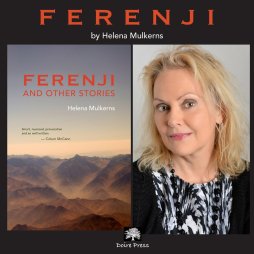
However, before I sound too grumpy, I loved Ferenji and Other Stories by Helena Mulkerns. Through the experiences of Western war reporters, UN, military and non-governmental workers, she pinpoints the absurdity and obscenity of war and the pointlessness and inevitability of poverty and corruption. Each story casts a long shadow and at the same time shines a light through her characters. They live in a time warp between the tarpaulins of the refugees and the drinking holes of the story tellers. The detail and honesty is interesting and I noted how important are small kindnesses and how love, even if only in affairs, becomes hugely significant. Helena Mulkerns writes with poignancy, simplicity and directness about war, greed, corruption and the powerlessness of people.

helena-mulkerns

All of which have featured much in my reading recently. Is this because society is saturated with such or infatuated with it, I wonder. Mind you, Alone in Berlin by Hans Merkell is a post war classic. It is based in Nazi Germany and follows the characters in an apartment block through the years of the war. It is a thread of horror, depicting both the weaknesses and strengths of individuals dealing with what seems to be an unfathomable corrupting force of power. There is no redemption for anyone – which I guess leads me to Trump’s presidency.

I find myself unwilling to add to the maelstrom of opinion but cannot ignore what is likely to be a pivotal point in history. I am scared…scared of more intolerance, injustice, violence; scared of division and the loss of my right to live in peace and comfort.  My recent reading only serves to heighten my fear. I do not think ‘systems’ and ‘democracy’ serve to protect people. I believe the forces of globalisation and rise of dictators are inextricably linked and dependent on war, greed, corruption and power. But, I feel too old and tired to galvanise myself to respond.

So, having said that, and having read the above books, I think I can make no better contribution to the debate than referring people to AESOP’s Fables – particularly what he says about kindness. At risk of sounding grumpy, old, and traditional or sentimental I find myself thinking (rather surprisingly) we can only be ‘rescued’ or ‘saved’ by our individual bravery, love and kindness. It is all I can suggest: be kind to each other.

velazquez_-_esopo_museo_del_prado_1639-41

AESEOP(or Æsop, from the Greek Aisopos) (c. 620 BC – c. 560 BC) was an ancient Greek fabulist of possibly African descent (his Greek name means Ethiopian or black man in today’s parlance), by tradition a slave who credited the African goddess Isis for his gift. Aesop’s Fables are still taught as moral lessons and used as subjects for various entertainments, especially children’s plays and cartoons.

Standard

The Work Ethic

As we slobbered over turkey, chocolate and glasses of bubbly this year, the subject of the work ethic came up. I googled it. The first definition was that the principle behind the work ethic is intrinsically virtuous or worthy of reward. I nearly choked on the dinner. Intrinsically virtuous? How often do those two words come together these days? That is some concept. Worthy of reward? That too has an 18th century ring to it. Does worthy of reward imply that if the work is rewarded, it is no longer ‘ethical’? The plot thickens. Further down the Google definitions, hard work and diligence were terms associated with the work ethic and it seems capitalists believe in its ability to enhance character. Well, they would, for an example of the work ethic was going into work when the boss wasn’t there or while you were on holiday (at that point we almost all left the Christmas table to rush to send an email into the office).

Work ethic. It has a Protestant ring to it and indeed, in Ireland anyway, it is ascribed to the Protestants, often with resignation and a sigh – sure, they don’t know how to enjoy themselves. So, is it someone who is driven to work, to succeed, to excel to the exclusion of all else – like John Banville who, I believe, suggested that good writers couldn’t/shouldn’t have children. In that case, is the work ethic a good thing?

I remember, as a child, it used to be ascribed to my father’s family who were Baptists from Birmingham (I think there may be a poem in that). But in relation to my dad, that work ethic label got changed to workaholic. He was passionate about his work in human rights, very committed, worked hard, was relatively successful, hardly ever at home and wasn’t paid much (actually, I think I could say the same for my mother who worked in education but then, she was at home a lot more which might explain her lack of work ethic). I think my father’s work was intrinsically virtuous and worthy of reward (as indeed was my mother’s) but in the liberal 60s and 70s the work ethic wasn’t very trendy so workaholic became the name of the game but always said with a stamp of approval. Workaholic is probably more accurate – after all ‘aholic’ denotes addiction, obsession, attributes which aren’t intrinsically virtuous or worthy.

Michael Viney of The Guardian says he inherited his work ethic (over Christmas he was gathering his intrinsically virtuous seeds for next year) from his father. Now, that is interesting. The work ethic does seem to be a male thing. You rarely hear of a woman being troubled by it despite often being responsible for running an office, a household, rearing children and usually working 16 hour days. Mrs Thatcher had the reputation for only needing four hours sleep; it was rarely described as a work ethic but then again, her work definitely wasn’t intrinsically virtuous. Maybe, to have a strong work ethic or be a workaholic you need to be selfish, arrogant, obsessive as well as have an irresponsible attitude towards family and community, ironically the most worthy and intrinsically important aspects of society. Yes, I think that might be it. That would also explain why the work ethic is not inherited by women. So, having worked that out, we went on to enjoy our Christmas dinner.

Happy New Year. I hope 2017 doesn’t trouble too many of you with a work ethic. One of my new year resolutions is to write as well as I ethically can and travel, that is, go on lots of holidays!

photo-10-09-2016-11-45-04

Standard

Home Sweet Home

I have enjoyed my first week in The Bungalow. I now live five minutes from Cavan Main St and I love the thought that down the road in one direction, people are drinking, eating, partying and, should I choose, I can roll down that hill and join in. On the other hand, after a five minute walk in the other direction, I can meander the forests, the wide open skies, the rolling hills, and lake sides, all burgeoning with ancient history and animal life. I am often struck by how much our earth teems with such different life forms and energies all at the same time – mice, moles, lions (the latter not in Cavan), people, war, love, happiness, hurt, hope, violence, death, terror and yet we all carry  on regardless.

This week, the Cavan evenings have been an artist’s dream. The bungalow nestles on the shore of the sky. Each evening, kippers of pink have rippled through the dusk, floating among the chimney pots and the starlings have choreographed perfect, mesmerising kaleidoscopic dances around the roofs and tree tops.

At night the glinting sheen of the orange street lights floods into my sitting room, casting my treasures into shadow. Coals glow in the stove beneath my Father’s square glass and brass clock on the mantelpiece. He was presented with it in 1981 at a Peace Congress in Berlin for services to Human Rights. The clock shows the time zones across the world. As I am writing, it is 3am in Bombay, now Mumbai. I love the tiny plane that is the second hand, circling the mountains, skyscrapers, and oceans of our world. It is one of my favourite possessions.

During the move, I discovered much about possessions. We have too many. When Indian tribes moved with the seasons, they simply moved with the tools they needed to reassemble. My move involved 150 boxes (we are a family of four I point out in defense but really that is no excuse) as well as beds, presses, tables, couches, carpets, dressers, chairs. It was interesting to note that what gave me most pleasure to handle and see as I unpacked: my teapot from Marrakesh, my Christmas cactus, and my House at Pooh Corner books, recipe books, a lava lamp,  my radio, a photograph, a rose tinted mirror, my dad’s clock, and my bed. I could have lived without most of the contents of the other boxes! However, having said that, I do rather like my new L shaped couch and the two suede leather recliners (another age milestone) that we have acquired since moving, not to mention the new Oisin Stoves in the sitting room and parlour. I also am fond of my potato masher and there are cooking pots that I especially like. And, of course, clothes. I particularly like my scarf from Peru, and my hat…and so it goes on. Possessions! Scientists need to identify that hormone, that gene that requires us to acquire and eradicate it!

So, this Christmas I am lucky. I am surrounded by my beloved possessions, people, houses, trees, lakes, sky, starlings, orange street lamps shining on the Cavan Street where I live. Home Sweet Home. It is such an important place. Apollo House in Dublin currently houses forty homeless people in Dublin as a result of direct action. I hope 2017 and more direct action finds more people safe in homes across the world. A home and shelter is a basic human right. Given the refugee and numbers of displaced people flooding across the land in 2016, and the forces of Brexit and Trump, it seems a little timorous and vague to simply hope for such things. I take off my hat to the homelessness activists who are actually doing something for people forced to sleep in doorways and on benches. We need more such well organised, unafraid activity to take on the rapacious and possessive cruelty of our ‘civilised’ society. Sadly, I am upon the age of the recliner, but young people of the world, do your stuff!

Happy Christmas.

Standard

Betwixt and Between. A Year of Comings and Goings

For me, it has been a year of high cobalt skies, a universe of cloud and ocean, cold and vivid colours, boundaries, borders and demarcation. It is as if the days have swirled past, like pages magically turning in a Hollywood epic while I, as its central character, flew to the top of its spine and watched the story unfolding. I wonder if this is because I have turned a leaf, a corner, entered a new age of few imperatives other than space and pages, words and fiction and the fear, unease and guilt that accompanies the days of a writer (particularly the novelist – I find the poet in me more languid) or the real world has taken leave of its axis.


This year has divided me into extremes. I have been either cooped up and immobile with my leg up (after my hip operation at the start of 2016), or on the move. Since April, every month, sometimes two or three times a month, I have found myself in the long, rounded, high rise glass tunnels of Terminal One, walking, tugging, running betwixt and between faces, places and people,  on my way or on my way back, on the conveyor belt, the travellator, or escalator, up and down steps between Dublin and London, across and back between ‘home’ and home, between mother and daughter, friend, brother, son, husband, Brixton, Clapham, Kentish Town, Galway, Limerick, Manchester, Ipswitch not to mention the delights of Athens, and Marrakesh. Now, in the last month, I make the final journey of the year: another move home, the move from Gowna to town, from Drumbriste House to The Bungalow situated on the corner of two roads in Swellan, with a high suburban hedge, under street lamps, across from hundreds of other houses, a short walk from the shops, pubs, library. Another Home from Home.


It is odd. All of these journeys have been dependent on me making them but I feel separate to them, as if I might be one of my own characters, not quite real, still coming into being. I think this is partly due to the real world being almost virtually unreal. Its pages may be turning fast, wars, Isis, corruption, Brexit, Trump, but despite my own fervent activity, my journeys, my travels, I am feeling a silent stillness, a separateness. It feels like time is at a precipice. From next week, I will watch the pages turn, (both real and fictional), snug in my bungalow, and will begin to unpack the hundred brown taped cardboard boxes (12” X 12” X 18”). Visitors are welcome. I cannot guarantee my state of mind but I can guarantee tea, elderflower wine, and cake. Together, we can toast the characters of 2017 or curse them, whichever.sky


Standard

Trumped by Nature

Trumped By Nature

When I finally closed my eyes to leave the twilight zone

Midnight had turned to 5am

Rectangles and squares had turned solid red

Angular, angry, abrasive

I could not see the swamps and seasons that shimmered beneath

nor the mists and oceans, prairie and land

It was difficult to see that sentience existed

people worked and lived

passion, vigour, reason existed

that these geometric shapes of inspiration and precision

were shuddering containers of human emotions


I awoke to my soft light of Irish day

morning white, grass green, sun rays

ridden roughshod by my Horseman and Scream

thick with fearful swirls of oil and edge

spiralling colour in mad descent


But, hard to believe, puppy dogs and rainbows emerged


I decided to walk, to think, to mind

to unravel, discourse, tick tock.

Out in the bog, my dog, Mary Poppins, and I

came across a puppy who wanted to play, jump, leap, chase

I watched his scampering bliss

Ignorance and happiness

Taking place beneath scudding clouds of grey and white, skies of blue and black, earth of gold and brown, arched by indigo, violet, red, orange, yellow, blue, green

It was my moment of why

While America tried to make herself great again

poppins and goldie.jpg

rainbow

Standard

DREAD

Do you know that feeling of dread when your skin crawls and your mind shouts NOooo? You shake with trepidation; your stomach reacts with bile but your moral compass is set and what has to be done forces your feet forward and propels your body in the right direction; you resist every taut, resistant hair in every screaming follicle, and you step into the fray, face the onslaught, the strangers, the danger, with heavy heart? Do you know that feeling?

I remember when I was three going to the beach for the first time, stepping down jagged, rocky steps of a rising cliff that towered into vast white cold skies,  my legs being scratched on clumps of heather, my tiny flip flops flailing against the sharp stones. I remember the rocks that lay like a black wet dinosaur, its skin cracked with crevices, brimming with water, turgid, slippery, slimy, green seaweed floating in briny pools,  scuttling crabs, barnacles clinging, cold winds wrapping themselves around my shivering body; reaching the cold expanse of damp, brown, solid grains of compacted sand; the noisy, grey tipped waves rolling closer and closer,  rushing in to overwhelm me, swallow me up, stiffen me in its smell of salt, standing, terrified, on the shore, cold water frothing over my toes.

My first day of school, I remember standing in the door of the classroom; the hubbub of voices, the blue of the screams, yellow taunts flying through the air, the white dry smell of chalk and blackboard tickling my nose, the scraping of chairs, chaos clattering, the wriggling hands inching up through the air to answer questions, a mangle of colours leaking from  the walls, and the safe quiet of day on the other side of the window.

Going to my first job interview, I remember the surprise of day light, the blur of buildings,  the stretch of electricity poles, the houses, gardens, shops flashing past after the train emerged from the tunnel into a strange world of suburbia. I hear the roar of huge aircraft and watch them, with their wheels lowered, criss-cross above me on their way to the airport and I wonder about the inevitable.

I remember leaving my home in rural Cavan one night  in brilliant moonshine, the shadows of myself and the bushes and trees looming bright black in the yard; turning and seeing my children silhouetted and laughing, their faces bright with pyjamas, TV and cheese strings and my reluctant heart getting into my car to drive miles and miles of dark country lanes, my headlights unraveling hawthorn, sycamores, snaking along the border roads, the moon now behind  clouds, driving back and forth across yellow road markings (the Republic), across white road markings, (The North), driving in bandit country, deserted, passing dark shapes of houses with one light on until I see the two cathedral spires of my destination cast against the Milky Way far away from where my children are safe in their shrouds of dark under duvets.

I remember the Old People’s Home where I travelled to read poetry last summer, the room full of dirty grey denier stockings on the withered stumpy legs of un-remembered old ladies slumped in their high backed chairs wearing green stained olive and navy cotton cardigans, splashed with food from today’s dinner of cauliflower cheese, (it reminded me of semen stains), their twisted faces lolled useless on wrinkled necks and shoulders, their gnarled, vein exposed hands, lay brittle in their laps, their grey hair hanging in streaks of grease and my words poised reluctantly on the tip of my tongue about to be rendered meaningless, uncared for, but I release them all the same hoping they find resonance.

I made all these journeys with a dreadful sense of dread.

But now dread has disappeared and I miss it. This morning I woke up to find my head was shaved. I realise that without my hair I can do nothing, go nowhere and I now understand the significance of dread. In dread there is direction.

kate 002

Standard

Making Sense of Pomegranate Soup, Elephant Ears, and The Plague… by a probably worthless existentialist


This summer has been a hot-pot of activity flavoured with fabulous food and intense reading. The Greek fare was great, lots of crispy sardines, mackerel, oily potatoes, feta, and tomatoes (I also got hooked on cardamom tea there).  The tagines, fruit, breads in Morocco were delicious, and the three pods of peas and six green beans from my greenhouse were very nice too. Wherever I have been, London (Sainsbury’s dates: succulent and tasty), Manchester (trifle and pork pies) Limerick (orange blossom rooibos tea), Galway (chowder and the Mezzine starter in Quay Kitchen) food is a factor. So I was delighted to read recently Pomegranate Soup by Marsha Mehran.

This is a quirky book set at the foot of Croagh Patrick about three Iranian sisters who were terrorised during the revolution. They escaped to London and poverty, worked their way up and came to open a small café in Mayo. She describes the traditional ‘mafia’ set up of rural village life and how the three sisters use their exotic recipes and dishes to entice the villagers into their hearts. It is a delightful book which shows rural life at its worst and its best and each chapter revolves around mouth-watering Persian dishes: Red Lentil Soup, Lavash Bread, Abgusht. One of the most intriguing sounding dishes is Elephants Ears (see recipe at the end). The story is full of drama, passion, greed, mysticism and revolution.

The author, Marsha Mehran, was the topic of a recent Doc On One programme (RTE R1) called An Open Verdict. Mersha, herself an Iranian refugee, lived in Argentina, America, and England. She eventually married an Irishman and had homes in Mayo, Leitrim and London. After her husband died, she became a recluse. In 2014 she was found dead in her holiday cottage in Mayo. She was lying down on her front on her bed, wearing only a cardigan, surrounded by saucepans of liquid, later discovered to be urine. There was no food in the place. A bizarre and sad ending to an author who crammed her book with food, life, love and revolution, all on the side of a mountain in Mayo.

Of course, drama, violence, love, and passion were the central themes of Elena Ferrante’s book ‘The days of Abandonment’. The book describes the tortuous experience of misery, fear, depression and madness experienced by a wife whose husband abandons her. It shows the slow deterioration of rational being with frightening clarity through detailed observation. Elena Ferrante’s writing reminds me of gamma rays. Gamma rays have the smallest wavelengths and the most energy of any wave in the electromagnetic spectrum. They are produced by the hottest and most energetic objects in the universe, such as neutron stars and pulsars, supernova explosions, and regions around black holes – such is the excellence of Ferrante’s writing. The character describes herself as experiencing an ‘absence of sense’.

“I had an excessive reaction that pierced the surface of things.”

“And where did you end up?”

“No where. There was no depth. There was no precipice. There was nothing.”

The characters of Pomegranate Soup were at the mercy of the world and Elena Ferrante’s character was at the mercy of her husband and own mind. I wonder if my reflection on a book influences my understanding of the next one?  After reading Elena Ferrante, I read The Plague by Albert Camus. In this he focuses on the reaction of various individuals living with death. A seaside town in France gets the plague. The town is isolated from the rest of the world and Camus uses this as a tool to show how, while we are social animals used to operating within the circumscribed restraints of society, it is only the reactions of the individual that matter and are the essence of life. Religion, love, community are worthless. It is only the self that exists. I suppose Elena Ferrante’s character reflected that too, and indeed, Mersha Merhan, herself. All very intense. I honestly don’t know how a ‘valuable’, ‘honest’, or ‘effective’ an individual I would be without my loves, community and beliefs.  Perhaps, I am worthless as an existentialist! However, (with a sigh) I would recommend all three books.  But, to cheer you all up, here is a recipe from Pomegranate Soup.

Elephants Ears

Ingredients

1 egg

½ cup milk

¼ cup sugar

¼ cup of rose water

½ teaspoon of cardamom

3 ¾ cups of all purpose flour

6 cups of vegetable oil

Garnish

1 cup of icing sugar

2 tsp of ground cinnamon

Beat egg. Add milk, sugar, rose water and cardamom. Slowly mix in flour, kneading to a dough. Roll out on clean surface with floured pin until paper thin. Using the rim of wide mouths glass or cup, trace and cut out a circle. Pinch the centre of the circle with thumb and forefinger to form a bow. Set aside. Repeat until all circles are done. Heat oil in deep pan. Fry each ear for 1 minute. Lay pastries on paper towels to cool. Sprinkle with sugar and cinnamon mixture and enjoy.

You know what, I think I will only read recipe books for the next few months.


Standard

MOMENTUM!

Yes!

A sleek black fish tail dress

A blowsy red rose upon my breast

Thus attired, my flittery feet twirl the best

Yes!


Yes!

A glass of white wine with a peppery zest

A hint of olives, pate, Blue de Bresse

Sauvignon Blanc swirls the best

Yes! Yes!


Yes!

Cuddly, sensuous, spidery sex

Slinky, romantic ascent to climax

After politics, food, wine, it is best

Yes! Yes! Yes!


Yes!

Jeremy Corbyn has the won the test

The man is principled politics in flesh

United workers march the best

Yes! Yes! Yes! Yes!


Keep saying Yes! It is momentous.

It takes a load off your chest.

Ride the crest of yes.

For, yes, tomorrow


We take over the rest of the world

jeremy

Standard