Revolutionary thoughts!

kate garden

A FB friend whom I don’t know well but I respect his posts, and therefore his views, commented recently that he thought democracy was no longer tenable and that he thought revolution was brewing. His comment made me wonder what revolution looked like these days. I  cannot imagine ‘the people’ flowing through the portals of the Dail, swarming through the corridors of powers and re-instating a new legislative assembly that would nationalise our assets, liberate our water,  and energy resources, invest in our island and  ensure equal status and pay for all. It’s not that I don’t want this, it’s just that I am not sure that the majority of people know what they want. People know what they don’t want. They don’t want too many taxes they can’t afford and they don’t want live in a society which is obviously corrupt and uncaring.

So what results do we want from our protest? We want jobs. We want enough to live on. We want homes that we can afford to pay for. And we want a health care service that looks after us, and we don’t mind paying for it as long as we have enough money. There is no evidence to show that we are overly concerned about revolutionary slogans such as fraternity, liberty and equality, as long as poverty, brutality, injustice are not shoved in our faces. After all, we have never lived in a fair and equal society.

Okay, we don’t like bankers, particularly when they make us bail out their debts. We don’t like politicians…why I’m not sure since we are the ones who put them there. But, we all know they are pivotal to the capitalist corporate system. But, we don’t really mind the system, once it doesn’t impinge too much on our individual selves, and we can’t see its internal workings. And anyway, what else is there?

Is this being very cynical or honest? I don’t know. Is my tongue in my cheek?

Revolution? I don’t know what system will improve our society, other than working democracy. A benign dictator might work to begin with. S/he may get national services running more effectively through ruthless organisation, but I am not sure it would last. And I think that society works better on a small scale where people participate in their own governance. The problem is that small, local governments are often insular and narrowly focussed and so restrict change and progression.

Sadly, the revolution in our society appears to have already taken place…the revolution of corporate business. Our world is now too interwoven and our societies are too inextricably linked through finance, communication, investment, and corruption for revolution to work. We are too comfortable. And comfortable people do not revolt with alacrity. We protest. And that is what we are doing, rightly so, in my opinion. It is good to see people engage. I believe the only way to sustainable change though is to inveigle our way into the system and ensure that we make it as fair and equitable, and as transparent and open as possible.

So we need to stand for election. And we need to organise to encourage and support people to stand for election. And we need more input into the politicians. Our local authorities need to be more accountable. Our local politicians need to engage better with civic society rather than on an individual basis. We need more women in government. We need more auditing and regulation. So, let’s do this in 2016. That would be one great way to commemorate the events in 1916.

Standard

The Firmament and The Stars

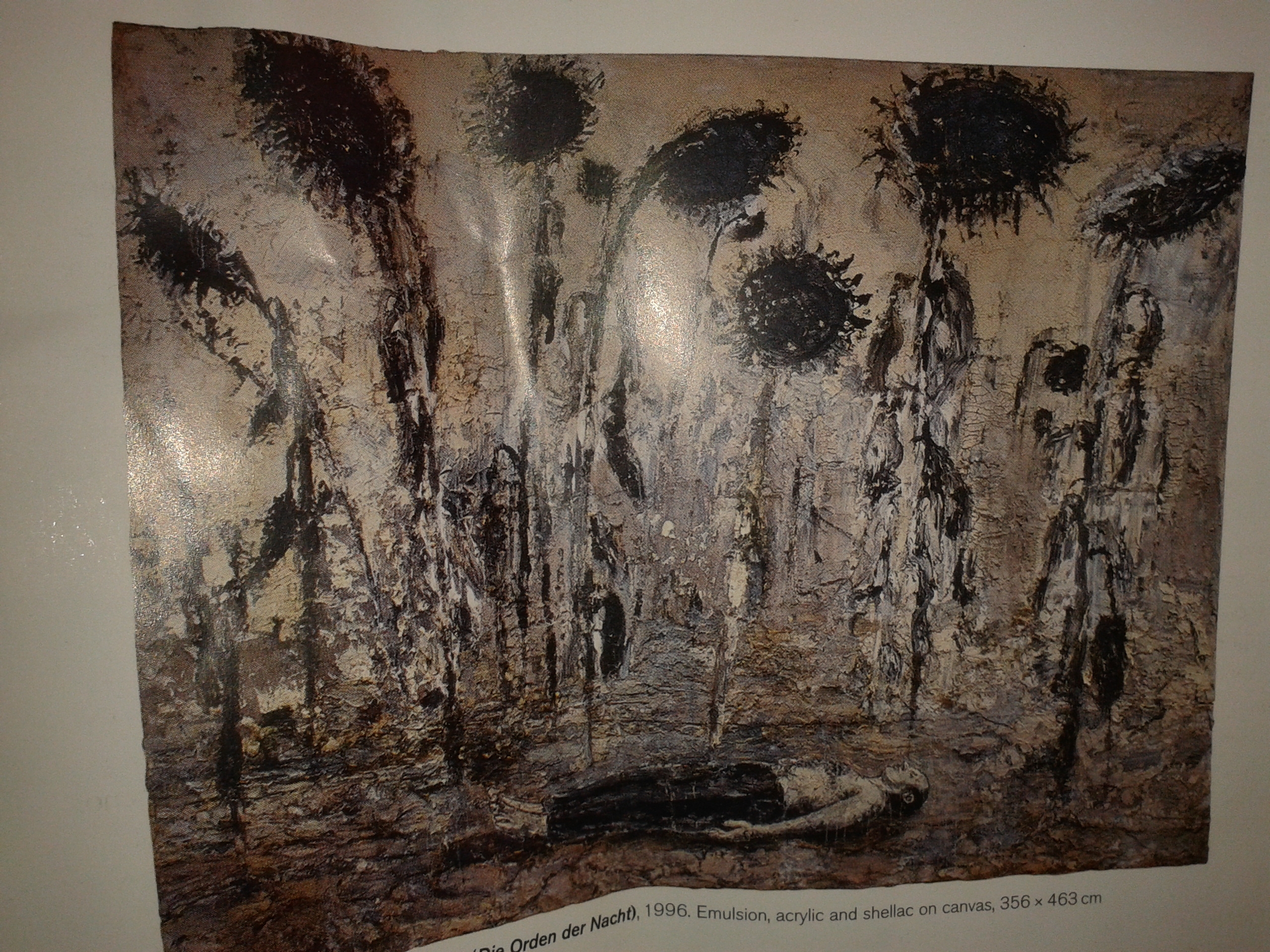
Anselm Fiefer's Sunflowers

 a bad photo of Anselfm Fiefer’s Sunflower

Isn’t it amazing how life unfolds? What is it that makes the world go round? How does each step lead to another? For instance, what made me buy a van in 2001, go on a family camping holiday, have a late night session with friends, at 7am the next morning hand the Sunday Tribune property pages to my 10 year old to read so as to gain  an extra hour, and consequently end up visiting an amazing ten bedroom house for sale, put in a mad offer on the afore mentioned house, have the offer accepted while in Kerry where I bumped into a friend who was an auctioneer who then practically sold my Dublin home by the time we returned from the camping holiday? Was it meant to be or did I determine it?

The links between coincidence, determination, and fate have always fascinated me. I like the phrase ‘self determination’. I think it combines two related aspects of the world: the mind of the individual and the force of evolution. It is interesting how they entwine.

This train of thought has been ranging around my mind recently as a result of my sojourn in London last week to celebrate my brother’s sixtieth birthday. It was a special occasion for him. Sixty years ago, it was a special day for my mother who gave birth to her first child. Two inextricably linked but very separate events strutting and fretting their hours across the stage. So I got to thinking about the impact of time, the role of circumstance and the minds of people and, coincidentally enough, I visited three very different exhibitions which also made me reflect on the nature of life and evolution. Each one, in different ways, made me conscious of the minute and the magnified and the connection between the smallest particle to the absolute whole, between the here and the there.

The three exhibitions I visited were Anselm Kiefer at the Royal Academy, William Turner at the Tate Britain and The First World War at the Imperial War Museum. For me, in very different ways, each one of them focused on the importance of detail in life and how extraordinary it is when you see the detail behind the creation. If it doesn’t sound too pompous, each exhibition captured the magic of art in that art happens when the essence of life, cause and effect, is captured on canvas, on the page or in the choreography of the installation.

The first exhibition I saw was the William Turner at The Tate. I have always loved William Turner’s sea and city scapes. I was introduced to him by my first love, so there is a sentimental attachment too which will generate its own spin on my mind, but I love how the washed out strokes of his water colour paintings create the broad watery surfaces of the ocean, the fading yet brilliant intensity of sunset and dawns. His yellows, burnt oranges, hues of blue and green draw me in to the paintings. Brilliant! After a minute or two of staring, out of the swirl of colour, out of the brush strokes of sea or land scape, the details of civilisation emerge out of the storm or trees. The fine intricate lines of distant churches, bridges, buildings slowly emerge through the light. Amazing! Suddenly you see, beneath the maelstrom, the detail of people.

Next I went to the WW1 exhibition at the Imperial War museum. This was detail in your face! Loud, graphic, brash, it leads you through the perils of nationalism, hatred, love, war using historical artefacts (uniforms, helmets, rifles, powdered egg) film, art, education. It is brilliantly curated so that you journey across all fronts (educational, emotional and actual war fronts). I left feeling assaulted, exhausted, and horrified at our capacity for destruction and exhilarated at our ability to survive.

Finally, after spinning through the crowds and queues of Piccadilly, I found myself staring at the enormous canvases of German artist, Anselm Kiefer. According to the ‘blurb’ Kiefer is absorbed by our purpose on earth and our relationship with the celestial and human history. His canvases are installations of sand, shale, concrete, paint, brick, sawdust, ash. He uses sunflowers frequently in his canvases. He said “when I look at ripe, heavy sunflowers bending to the ground with blackened seeds…I see the firmament and the stars.” I loved the contrast and contradictions of humanity, destruction, re-birth and re-construction in his work.

So who are we in this universe and what role does each of us play? Are we each a black sunflower seed? We need to determine for ourselves but we cannot without each other or the various constructions we or the universe composes. To celebrate his birthday, my mother had to give birth to my brother.

Even now, here, as I write with pen and paper in the year 2014, alone in this dark early morning, in the lamplight, in the middle of nowhere, my meandering thoughts are yielded to the page and transferred to you, the reader, forcing you to stir (be it with boredom, heavy sigh or amusement), yet that is not my intention. I just want to decipher myself, but in so doing, I need you to help me by being there. So, thanks for that!

Standard

How I Got to Know Kavanagh

kavanagh

I spent yesterday afternoon on the couch wrapped in shawls and blankets, reading Kavanagh’s poems, eating oranges and ginger parkin and watching rugby. Not such a bad way to spend a Saturday afternoon in the border counties. A poem in itself, really. I wonder what poetry it might have inspired from Kavanagh.

I had not been a fan of Kavanagh (pleasread as an embarrassed mumble). I could not understand the general adoration the Irish seemed to have of him. I put it down to the occasional Irish streak of sentimentality. I thought maybe because I was a Londoner, I was not able to  truly appreciate his rural ‘bent’. When I came across a Kavanagh poem in an Irish poetry anthology, it seemed to wallow. (Anthologies can be a poet’s worst enemy). Yesterday, I discovered I was wrong.

Despite being a writer of poems, I do not often sit down and spend the afternoon with one poet. I will do this more often now. It was a complete pleasure. That evening I was going to  The Haggard (see blogs Sept/Nov 2013) to watch a one man show by Cavan man, PJ O’Brady on the life of Kavanagh. I thought it might help to have a deeper look at his poetry.

Regular readers of this blog will know I am a blow in. By the end of the afternoon I was trying to recall what on earth had made me blow in, and worse, live in this God forsaken, narrow minded, barren, cold community where little existed except for frosty potatoes, thorns, and a man’s Great Hunger. And, as does occasionally happen, a great longing came over me to leave (I have to say, soon assuaged by another cup of tea and a slice of cake).

But what wonderful and gifted poetry! With a cruel, bleak eye and up right, curmudgeonly hand, Kavanagh was able to capture the bitter sweet taste of the lonely, isolated inhabitant living in a barren land, the wealth of nature toiling on the ribs of poverty, the stinking growth of grievous disappointment, the riches of human life in a rigid rural community defined by religion, pride and conflict. Gerard Smyth, Irish poet and editor, said poetry “recognises the world in a different way,”  Kavanagh certainly does this.

I will forever be in the debt of PJ O’Brady who did a wonderful depiction of Kavanagh, interleafing with intricate skill Kavanagh’s poems with the biography, The Green Fool. I also want to thank Michael Masterson of The Haggard in Longford for staging the show and Julie Shiels for suggesting we go.

Standard

Me and My Cheshire Cat

kate garden

It’s been an odd week. It has been frenetic and fun but I have also felt oddly removed from it as if I was watching myself, rather than taking part, if that makes any sense. I feel like the Cheshire Cat has joined me (the smiling cat from Alice in Wonderland which occasionally appears to Alice and talks – at least I think that is what happens, I haven’t read it for 50 years). When I was younger, each day led to the next, and was part of the whole; life belonged to me; it was mine. I didn’t notice time go by. I certainly didn’t notice Cheshire Cats! Now it is different. Each day is an individual day  and is slightly tiring. Each event in a day is a discrete one, rather than an integral part of my life. Each day is what I consciously choose to do rather than unconsciously experience.

Last Tuesday, my Cheshire Cat suggested I  get off my arse and go out. Later I slightly regretted our ‘conscious’ decision to go and see Inside Llewellyn Davies, the new Cohen Brothers movie at the Ramor Theatre in Virginia. The film was set in the 50s and 60s and was about ‘loss’ and the ‘failure’ of  singer, song writer, Llewellyn Davies. I found it lack lustre but dark. Oddly enough, though, it was the first event of a week that focussed on the past, loss, old friends and family in Cavan, Dublin and Galway.

On Wednesday evening ‘my poets’ read their love poems in the workshop I facilitate and discussed loss – the theme I had chosen. (I should say, my Cheshire Cat rarely appears in relation to my writing. Is this significant?) We read elegies and poems about death. While their poems we workedshopped a week later were very good, and it is a good theme, it is also a very dispiriting one. I came home, head in a cloud. So, when on Thursday I headed off to Galway for my poetry workshop and to go to Over The Edge with my friend Patrick, I was pleased to be heading for the clear skies of the West.

Patrick is an old friend of mine from England whom I have seen only twice in the last 30 years (different countries, marriage, children make it hard). He and I worked together in London during the eighties for the Labour borough councils. With our trusty type-writers, and fighting words, together we battled the Thatcher policies on local government cuts, rate capping and poll tax campaigns. But last Thursday, instead of politicking we were frolicking. Patrick is now doing  an MA in Writing in Limerick and so once again we were sharing passions and comparing notes. Sitting outside in the balmy winter weather on Quay St, we ate, drank and chatted about the poetry of life and love. It was as if the years had never passed. My Cheshire cat faded away!

I drove back to Cavan the next morning, feeling depleted, (more ghostlike than catlike) and was brought back to the present when I  discovered a  ‘homecoming’ was on the cards for that evening. Son was already here helping clear fallen trees and Daughter was on her way. A family dinner with all the accoutrements was required. Donning the mother mantle, I cooked roast chicken, parsnips, carrots, green beans, mashed potatoes, and it was all washed down with lashings of wine accompanied by love, laughter, bickering, and finally bed. Too busy to consider cats.

We all surfaced the following morning, misty minded, and set off on our different trajectories. Róisín (daughter) and I headed to the National Gallery in Dublin to peek at The Old Masters (and one Mistress) and an exhibition ‘Lines of Vision’ (highly recommended). This was  followed by dinner, a jug of sangria and a memorial concert at the National Concert Hall to celebrate the life of  John Ruddock, the father of one of my oldest and best friend in Dublin, who died last year. The concert was performed by the Vogler Quartet and the Scharoun Ensemble. I am not a follower of classical music or quartets, but to watch the musicians perform in the NCH was pure magic. The strings led and the wind followed, chasing their notes until they were perfectly inseparable. I cannot describe it. It was captivating. I know because I could see My Cheshire cat on the bar of the balcony with a big grin.

Yellow sunshine, blue skies, and that quiet, almost eerie calm of a Sunday morning in Dublin streamed in through Roisin’s bedroom window the next day. I got up and picked my way through the clothes strewn floor of my daughter. We had ended our musical evening with Graham Norton, Ann Hathaway, and a bottle of Aldi’s pinot grigot on the couch. After a cup of mint tea (no milk in the house) and a motherly daughter clash on  how to iron a ridiculous wrap around Penney’s garment, we set off over the hills to luncheon and reacquaint ourselves with our old and dear family friends.

We were armed with a delicious strawberry cheesecake from the Ranelagh Natural Bakery. It was oohed and ahhed at and joined an array of other lemon, raspberry, and strawberry cheesecakes, two banoffi pies, a remoulade, and a gluten free chocolate cake on the dessert table! They all looked very imperious, but an army of spoons and forks soon turned them into a veritable battle ground. The Cat had to fade rather quickly to escape injury! The white wine was gorgeous, and the house soon filled with musicians, my friend’s family, neighbours, and chit chat. It looked lovely. I didn’t watch myself mingle. I preferred to help with the food. At sunset, I took my leave and travelled north. The Cheshire Cat, snuggled on the passenger seat, talked to me as we wended our weary way to Cavan, to my own sofa, egg and chips, to watch Peaky Blinders (the BBC equivalent of Love/Hate set in the 1920s). Once there, the Cheshire Cat was chased off by Poppins, my real puppy.

The week ended  with more poetry at AT The Edge, Cavan. Kevin Higgins, Susan Millar du Mars and Philip Doherty read wonderful poems and short stories and the Open Mic was great. There was a good crowd and I was delighted. It was a success. I could be pleased, I told myself. The Cheshire Cat that sat on the podium with me as I curated the performance felt like the cat that got the cream. Later our visitors and I stayed up drinking in front of the fire, telling each other the different stories from our pasts. There are so many stories that make up a life. When we were young we had no stories to talk of, it was all about creating them…we wanted to change the world!

So my Cheshire Cat…maybe she is my inner being taking form. Maybe Philip Pullman would call it my daemon. Maybe she is my voice of experience. Whoever she is, I am learning to accept her as part of my life.

Standard

Thinking About It

The Thinker

I want to know how to think. I want to train my mind in a useful way so that my thinking is a constructive process. I am tired and exhausted with my messy thinking methods.

Yes, my thinking is an untidy business. I am doing it all the time, but I am unaware of its taking place in any coherent way. I remember asking my mother when I was about five how to think. She told me that we think all the time. It comes naturally, as sentient beings (she probably didn’t use the word sentient). Well, it concerns me that I am constantly doing something that I don’t understand and that seems so ineffectual and doesn’t do very much for me.

My inner conversations are haphazard and incomplete. I have a one sided voice that constantly doubles back and questions itself  and doesn’t come up with any solutions. My thoughts conjure up images in my mind that then disappear within seconds in a blurry mess. I don’t know if I ever a complete a line of thought. I think Rodin’s ‘The Thinker’ is completely inaccurate. My thought patterns are more like a Picasso, full of lines, figures, bends, and shapes with a splash of colour here and there.

Now, I don’t want to appear stupid. Of course, if I have an objective, like at work or cleaning house, I can develop a strategy. I can plan a course of action. I can do linear, sequential planning. I am good at ideas and making connections. I like people and ideas and conversation. But my abstract, alone thinking is messy.

My thinking feels sluggish, like some amorphous body, a slow crawling insect or maybe an octopus thinking with its tentacles. I blindly thrash and grasp at intangible and far stretched, contorted ideas. I try to straighten them out, turn them into lines of text that I can read and turn into a strategy. But then I forget the thought altogether and I find myself swimming, or cooking or cleaning the floor.

No my cogitating isn’t pretty and is completely untrained. I find my inner wishes trying to manipulate my thinking. My dreams interfere and kidnap my thoughts. I find I try to weave my thinking from the fabric of my desires. Then, I have to guillotine those thoughts and do something.

Maybe I cannot think clearly because I am a doer. Do I like to do because it distracts my thinking? I don’t know. I cannot think about it now. Let me know what you think.

Standard

No Mean Feat

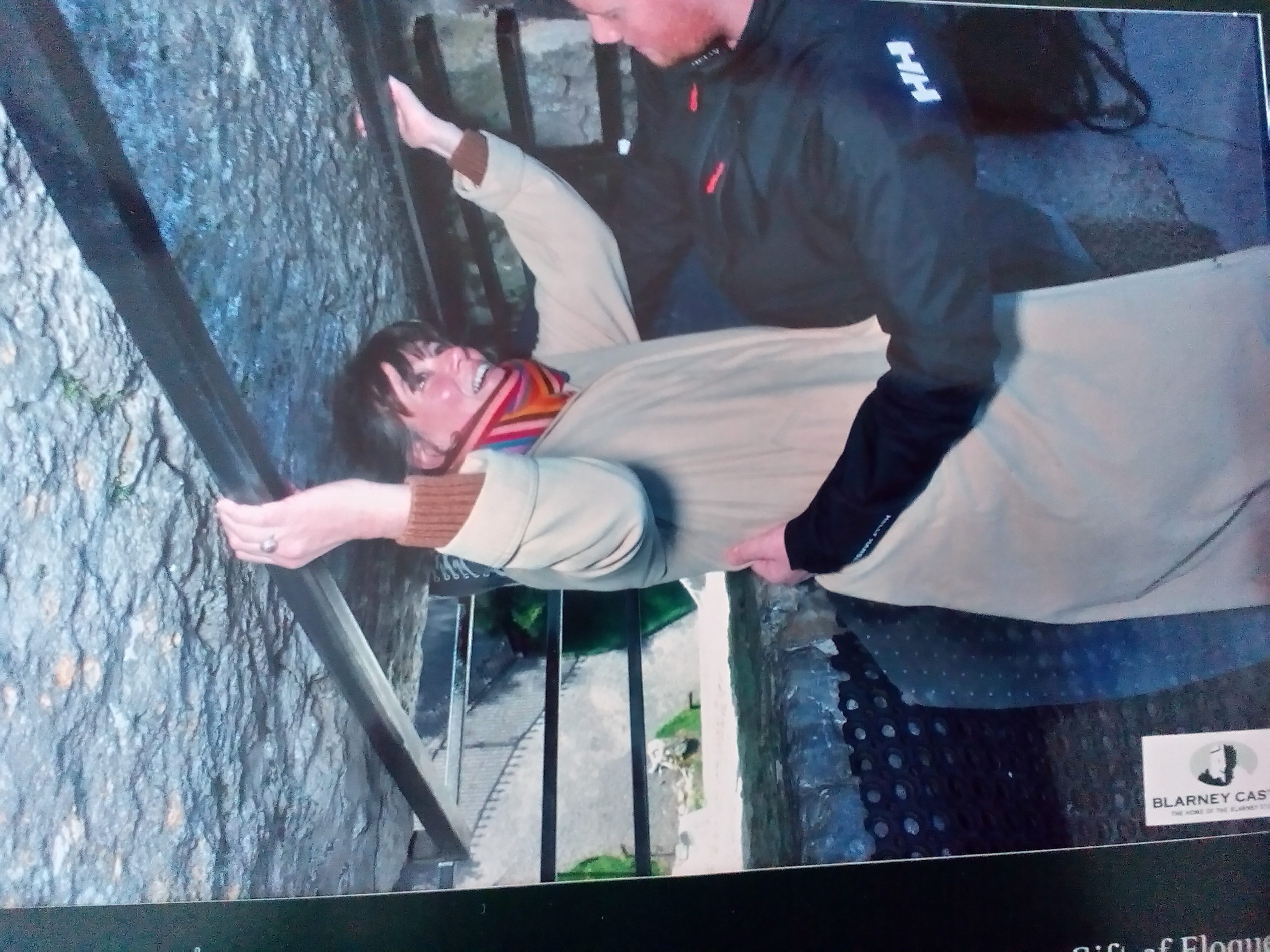
I have just kissed the Blarney Stone and it was no mean feat. First you climb a 50 metre shrinking spiral stone staircase in a narrow stone tower on tip toe. It shrinks because each step gets smaller the higher you get (remember  in the 16th century folk were only about five foot high and had small feet, and I am 5’10” with size 8). You then lie down on your back on the parapet, hold on tight to iron bars, lower your head backwards before planting a smackeroo on something the fella holding on to you says is the Blarney Stone. It was amazing. I sat back up and burbled a stream of witticisms and esoteric terminology never before heard.

I was impressed with the Blarney Castle experience. The castle itself is exciting with towers, turrets, murder holes, bathrooms, dungeons and even a ‘family’ room. I could just imagine Chief Cormac MacCarthy and his three girls (who also had their own dressing room above) snuggled up next to the roaring fire on which a wild boar was roasting and watching Disney films.

The gardens are varied: wonderful herbaceous borders, poison gardens, arboretum and pinetums, sculptures, lake paths, and woodland walks with strategically placed cafés and gift shops where you can purchase Blarney Stones (but it won’t be as good as the real thing).

So, I am in Cork, celebrating twenty five years of marriage. We spent our first night in the city. I had booked us into the Cork Opera House for a treat and a bit of culture. It was a one man show written and performed by Ray Scannell called Deep. The blurb described it as a multi media performance depicting the social and political influences of Cork in the eighties through music. Interesting, I thought. So bright eyed and bushy tailed (that’s the Blarney stone coming out), we presented ourselves in the grand  foyer of the Cork Opera House only to be shown the door and told to go round to the back entrance which was carpeted with cigarette butts and flyers. There we were directed into a small room with a stage and 15 rows of plastic uncomfortable looking chairs. Ah well, the best laid plans and all that…

The show, though, was mesmerising. Depressing, heart rendingly bleak but brilliant. When we sat down in the plastic seats, the multi media backdrop suggested this was a show about house music. House Music??!! Where had I brought us? Ah well, maybe I’ll be able to impress my son with my newfound knowledge, I comforted myself. But the show was riveting. Ray Scannell performed as a DJ taking us through the story of the absolute joy of a young teenage boy caught up the discovery of a new, different, compelling music in a local Cork night club which spilled into dance, love, drink, drugs and more drugs against the backdrop of unemployment, poverty, violence, emigration, loneliness. It was compelling, haunting and cleverly done. Check it out if you get a chance.So twenty five years of marriage…also compelling, cleverly done and certainly no mean feat.  Not sure it’s a performance you’d want to see!

blarney stone

Standard

Fabulous Fecund Females

aisling and kate

Aisling Blackburn with her portrait of Kate Ennals at the Exhibition, Fabulous Fecund Females in the Solar Gallery, Ballinamore

Last night I went to the launch of the multi media exhibition of Fabulous Fecund Females created by the wonderful Aisling Blackburn in the Solas Art Gallery in Ballinamore. It is an assertive exhibition of colour, vibrancy, and power. And women. Aisling photographed 12 women (I am one), and then painted our portraits and finally got us to sit in front of a video camera. The idea behind the project, Aisling said to me when she asked me to participate, was the portrayal of strong women. I was flattered that she considered me a ‘strong’ woman, and happily agreed.

It was a strange experience being photographed. Aisling wanted me relaxed and comfortable in my own environment, but I am not used to cameras and felt uncomfortable standing in front of  a camera, doing nothing. I find it unnerving being the centre of attention unless I am demanding it with my naturally witty or intelligent remarks (!!). So I decided to recite a poem. Due to my age (and years of drinking) I can’t remember any poems, so I had to read from a page I held in front of  me. This, of course, ruined the picture. Aisling was very patient.

What did I think of the final result? I was taken aback. I didn’t realise I looked so weathered, so wrinkled, so old. When I peer in the mirror I don’t see it. Isn’t that interesting? But I liked them. Aisling did catch me. It’s strange to be captured in a photograph. I also liked the portrait Aisling did. I think it was one of her best. She threw herself into it. I can feel her in there with me. I didn’t like the video, the experience of sitting for it and sitting watching it. So the art I liked best was the part in which I played no part…the portrait!

I really enjoyed the exhibition. Fabulous Fecund Females. It was very interesting to examine the photographs, see the portraits that Aisling had drawn from the photos and watch the video of the women’s faces, live. The exhibition is vibrant. It is worth the trip to Ballinamore, which is also a lovely town. A great trip out and lunch, maybe,

As I was leaving, it occurred to me that all the work of art was for sale. I love my portrait, it’s  a great painting, so  suppose some one else does and buys it (I’m a bargain at €300) and hangs me in their home. The thought made me shiver.

“Aisling, if someone wants to buy my portrait, I need to know who,” I say.

Then it occurred to me that I should list the criteria that the buyer should have. After all, I am a strong woman and have ideas about where I may be hung! Then I thought of my poem, Please Can I Have a Man that was shortlisted in the Over The Edge poetry competition last month (see below). It would probably do. I think Aisling should hang it next to my portrait. Enjoy the exhibition.

Please Can I have a Man…

after Selima Hill

Please can I have a man…

tall  and carved,

so I can clamber up him

to blue skies painted with coloured clouds;

a sculptured work of art,

cast with grandeur and humility,

all his limbs intact for me to touch,

whose stomach ripples with giggles,

who loves so much

to hear me rant and rave

watch me misbehave,

who adores my feminine intuition,

gives me looks of admiration

when I make particularly insightful remarks

on politics, the weather, poems, art.


Please can I have a man

who can move with rhythm,

and bend his body to fit mine

when I dance

in the kitchen

A man with long tapered fingers

dressed in a dark sharp suit

who stirs a wooden spoon

through my swirling steaming pans of soup

made with spices, peppers, garlic, ginger,

who sticks out his tongue,

pokes fun,

who will grin and bear it.

A man engorged with the scent

and headiness of it all


And, please can I have a man

who will be different tomorrow because I’m likely to change my mind.


Standard

Lunch in Mumbai

lunch box image

I went to see a wonderful Indian film last night at the Ramor Theatre, The Lunch Box. It was set in Mumbai and was a slow moving film set within the frame of the frenetic and bustling tenor of a lunch delivery service in the city, which, when I googled, I discovered is called the Dabbawala. It is an extraordinary service:

 ‘Dabbawallah is a person in India, most commonly in Mumbai, who is part of a delivery system that collects hot food in lunch boxes from the residences of workers in the late morning, delivers the lunches to the workplace utilizing various modes of transport, predominantly bicycles and the railway trains, and returns the empty boxes to the customer’s residence that afternoon. They are also made use of by prominent meal suppliers in Mumbai where they ferry ready, cooked meals from central kitchens to the customers and back.http://en.wikipedia.org/wiki/Dabbawala

In this film, the lunch made by the lonely young wife for her ‘never at home’ working husband is delivered to the wrong person: an older, rather grumpy widower about to retire. The lunches look delicious and come in five cylindrical, silver lidded bowls that lock into each other, containing breads, curries, vegetables. They are then put in a vac pac holder to keep warm. But the story is about the notes that the mother and the widower exchange.

His first note complains of too much salt. She responds by putting too much chilli in one dish.  But from there on in the notes  in the lunch box are used by each character as a means of expressing a fear, a thought, not necessarily seeking attention or advice but looking for a listener. For me, the film is about the importance of expression.

Interestingly, in Mumbai a number of languages are used: Marathi, Gujarati, Kannada, English, Telugu, Konkani, Dangii, Varhadii and Hindi. Ironically enough, this must serve to lessen communication in one the most populated cities in the world. In the film, the language in the notes that the audience saw was English but there were sub titles for the conversation, which I think was Hindi or Gujariti, though often greetings, or phrases were also in English. Language and expression certainly does get complicated in our gobal world.

But what I found  interesting was the content of the notes. They were simple observations, personal reflections, memories. They did not seek advice, or solutions. They were exchanges. But this simple exchange of written words engendered interest and excitement  for each of the characters and led  each one to create change in their lives.

I don’t want to give more away so I won’t discuss it further, but watching the film, I recognised the importance of my own need to state, tell, and describe what I see, hear, and feel. It provides me with  form, reason and  context. Maybe we are losing this in our virtual world.

I lost someone once, and one of the things I missed most what not being able to write notes and messages to that person describing how beautiful an autumnal evening was, or how the morning sun light behind my curtains suffused my bedroom in a glory of soft expectation. In losing him I lost a conduit of expression.

Freedom of expression isn’t only a political and social right, it stems from a basic human need. I recommend the film.


Standard

Birches with Sexual Overtones


birch trees

At risk of courting an avalanche of mirth, or even worse, scathing academic scorn, I want to write about my ‘analysis’ of ‘Birches’, a poem by Robert Frost ( see copy below). But first, by way of self justification, I just want to say I agree with one of my poetry workshop participants last night who said that what she loved about poetry was how every poem, whatever the intention of its author, becomes the possession of the reader  because it is the reader who interprets its meaning.

So, that said, I’ll continue. According to general literary commentary, the poem, Birches, is about truth and imagination, heaven and earth, control and abandon, flight and return. I quote sparknotes[i]

The whole upward thrust of the poem is toward imagination, escape, and transcendence—and away from heavy Truth with a capital T. The downward pull is back to earth.”

However, when my friend and I read the poem, we came up with another interpretation. Is this poem about the adolescent awakening of boyhood sexuality? The following two lines provoked our initial questioning.

Like girls on hands and knees that throw their hair

Before them over their heads to dry in the sun.”

Both of us felt uncomfortable with the two lines. We felt they were at odds with the previous naturalistic bent of the poem. The image was strange. The girls must be there for a reason, I said. Let’s go back and look at the poem to see if there are other similar references. And suddenly, we could see them everywhere.  So, I came to the conclusion that swinging on the birch trees was definitely akin to the early sexual experience /lustful thoughts of a young boy. Now, I don’t know whether one can make double entendres of anything once one has the idea, but, given the earlier assertion that the poem is owned by the reader, this is now my official interpretation. My friend is less sure so I am putting forward this argument to see what others think.

Here is my brief justification:

For me, the portrayal early in the poem of the birch covered in ice and sun, blowing in breezes  in the sun’s warmth, “as the stir crazes and cracks their  enamel” has a feel of awakening, and stirring of emotions.  The line “You may see their trunks arching in the woods” just before the lines about the girls on hands and knees has sexual over tones and surely the reference to the dome of heaven “fallen” could refer to the early orgasm. I wondered whether the young boy who does not have the  distraction of sports, “whose only play was what he found himself” also suggests this. The use of the word ‘subdue’  which has connotations of  sexual power in relation to his father’s trees (the birches) is  strange, as are the following few lines:

“One by one he subdued his father’s trees

By riding them down over and over again

Until he took the stiffness out of them,

And not one but hung limp, not one was left

For him to conquer. He learned all there was

To learn about not launching out too soon

And so not carrying the tree away.”

They seem to me be to  refer to a boy exploring his own body and sexuality. Frosts description towards the end of the poem could easily be describing the joy and exultation of the sexual act; its reaching for escape, the tip of the world, and returning to earth which is the ‘right place for love.’

I am not a poetry critic, other than in appreciating what I like and understand. But I wanted to write this as we haven’t been able to find any other reference to such an analysis in relation to Birches, and as a result, began to feel ‘wrong,’ and ‘stupid’ and ‘way off course’. But the poem is ours now, whatever Robert Frost intended. And, I like it better.  There is the ‘solar’ (the sense/meaning),  the ‘lunar’ (the sensual, the beauty), the ‘musical’ (the tone, the sound) and the ‘visual’ (the form); the poem is a torrent. Unlike, The Road Not Taken, there is no particular form… as is the case with young adolescent boys.

So, I rest my case and hope you enjoy the poem…do let me have any thoughts!

On a more personal note, I am really looking forward to reading in Galway tomorrow (Culture Day) twice! In Clifden at the Arts Festival I am reading my poem, The Ancient Song of the Pebble, published in the last Skylight 47 and then in back in Galway City I am reading Please May I Have a Man, long-listed in the At The Edge competition this year. Then back to Cavan at 10pm for the Trans-Art event celebrating Dermot Healy!

Birches

BY ROBERT FROST

When I see birches bend to left and right

Across the lines of straighter darker trees,

I like to think some boy’s been swinging them.

But swinging doesn’t bend them down to stay

As ice-storms do. Often you must have seen them

Loaded with ice a sunny winter morning

After a rain. They click upon themselves

As the breeze rises, and turn many-colored

As the stir cracks and crazes their enamel.

Soon the sun’s warmth makes them shed crystal shells

Shattering and avalanching on the snow-crust—

Such heaps of broken glass to sweep away

You’d think the inner dome of heaven had fallen.

They are dragged to the withered bracken by the load,

And they seem not to break; though once they are bowed

So low for long, they never right themselves:

You may see their trunks arching in the woods

Years afterwards, trailing their leaves on the ground

Like girls on hands and knees that throw their hair

Before them over their heads to dry in the sun.

But I was going to say when Truth broke in

With all her matter-of-fact about the ice-storm

I should prefer to have some boy bend them

As he went out and in to fetch the cows—

Some boy too far from town to learn baseball,

Whose only play was what he found himself,

Summer or winter, and could play alone.

One by one he subdued his father’s trees

By riding them down over and over again

Until he took the stiffness out of them,

And not one but hung limp, not one was left

For him to conquer. He learned all there was

To learn about not launching out too soon

And so not carrying the tree away

Clear to the ground. He always kept his poise

To the top branches, climbing carefully

With the same pains you use to fill a cup

Up to the brim, and even above the brim.

Then he flung outward, feet first, with a swish,

Kicking his way down through the air to the ground.

So was I once myself a swinger of birches.

And so I dream of going back to be.

It’s when I’m weary of considerations,

And life is too much like a pathless wood

Where your face burns and tickles with the cobwebs

Broken across it, and one eye is weeping

From a twig’s having lashed across it open.

I’d like to get away from earth awhile

And then come back to it and begin over.

May no fate willfully misunderstand me

And half grant what I wish and snatch me away

Not to return. Earth’s the right place for love:

I don’t know where it’s likely to go better.

I’d like to go by climbing a birch tree,

And climb black branches up a snow-white trunk

Toward heaven, till the tree could bear no more,

But dipped its top and set me down again.

That would be good both going and coming back.

One could do worse than be a swinger of birches.


[i] http://www.sparknotes.com/poetry/frost/section8.rhtml


Standard

Musing from London

I am back in London, sitting up in bed.  I am supposed to be working on a poem (my focus is on form and structure). I look out of the window into the rows of London gardens: brick walls covered in ivy and wisteria. The leaves on the gigantic tree opposite are on the turn: beautiful green, yellow and orange. At the end of one branch, gold burnishes. Every so often a leaf flutters down. I am also listening to a politician, Lord Carrington, I think it is,  on the radio discussing the problems of the ‘land issue’ when handing Rhodesia back to the Africans. I am on Facebook too.

So, can I be accused of procrastination? Actually, I think procrastination gets a bad name when in fact it is rather a delightful occupation. It is like the foreplay to sex. It builds up tension. Abstract, unfocused thinking leads to slow notions, and ideas. I often start scribbling when I have no idea of what is coming but , usually, the flow begins and the links emerge. (A caution here, when I say links, as my idea of links can be rather haphazard!)

So while listening to the discussion of Rhodesia/Zimbabwe’s experience of growing independence,  I hear about the multilayered issues, the local politics, the  economics and personal enmities involved while also reading a FB comment about what happens to your Facebook stream if you ‘like’ posts. As I listen to the radio, what strikes me (again) is how we so easily make judgments, form opinions without fully understanding the whole equation (independence for Africa). I suppose, it is essential we do this, for if we knew the whole picture, understood the intricacy, it would inhibit us from action. Passion is necessary for action.

Back to FB. One of my ‘friends’ (well, more of a colleague than a friend, you know FB) informs me that a friend of hers was testing the benefits of ‘liking’ on Facebook. Apparently,  not ‘liking’ improves your FB experience. It seems the algorithm that Facebook uses doesn’t discriminate between showing us the sweet kitties we ‘like’ and the cruel torture of cats we don’t, and sends us pictures of everything feline. I don’t really understand how FB works, I thought I simply received material shared by my ‘friends’. (Isn’t it strange how many inverted quotation marks need to be used when referring to FB). So, the ‘study’ carried out indicates that it is much better to comment. Comments are not part of the algorithm and therefore don’t attract ads. Comments make your FB experience more meaningful. An article on the experience of ‘not liking’ was posted. Apparently, it had been difficult not to ‘like’. The author felt guilty she wasn’t ‘supporting’ her friends and even that by not ‘liking’, she was expressing disapproval. Then she read an article about someone who had done the opposite and liked everything and his feed had become a terror ridden, and tense, full of horror and gore.

It was the feeling of guilt when she didn’t ‘like’ that interested me. It is absurd, but I know what she means. Our ‘liking’ something on FB  is pretty meaningless, but it is seductive as it shows we support people without having  do anything. What bliss! But I’ve decided I’m going to reduce my ‘liking’ and comment or share instead.

What has this to do with Rhodesia/Zimbabwe? I don’t know except that maybe those ‘inverted quotation marks’ reflect on how little we all understand or really know what is going on in our world – despite the communication – whatever the time frame. I like FB.  I enjoy reading which ten books have impacted on FB ‘friends’. I like knowing what people are up to  (particularly Lesley who travels the world). I like putting pictures and comments about my AT The Edge, Cavan literary nights and poetry workshops (next one starts Wednesday 17 Sept). I feel FB keeps me in contact. It reminds me that ‘friends’ are out there, and that they are, or have been, a part of my life! All a little superficial? Probably, but that’s okay. However, from now on, I will ‘comment’ rather than ‘like’ so if I don’t ‘like’ your postings, don’t be offended and I’ll try not to be if you don’t ‘like’ mine. You can comment instead!

kate 001There drops another golden leaf in the garden…

Standard