Flying in Circles

The planes are back spinning above my head and the tubes rumbling beneath my bed in Stockwell, London. I presume that the powers that be have succeeded in changing night operations to day and that everything in our skies is back under control. It is a riddle is it not? How mankind can be so brilliant to put planes in the air but ridiculous enough to forget how to land them? I was dreading my journey from Cavan this weekend when I heard about air traffic control problems, but in spite of cancelled flights, I arrived, as I said I would to my mother, at the dot of 5.30pm. Calamity and chance worked for me.

             So here I am back in London town. I am choosing which exhibition to go and see, which part of the river bank to stroll along, which museum to visit, where to shop. I will miss the Pop up Art shop being set up at 61 in Cavan, but I hope to get back to go to the Hanzel and Gretel performance next Saturday night.

             Not for the first time, it struck me last Friday evening when I was still in Cavan at the Finale Show of the Culture Cavan project, just how rich in culture, art and talent, Cavan is. The Cavan Choir was wonderful (I still don’t know how they reach those notes), I loved the Cavan Big Band (what an age and musical range), Aine Cahill has a wonderful voice and the Bailieborough School of Music…I have never seen such large recorders! Sadly I missed the later musical acts as I had to go a Father Ted quiz being run by the Community Radio. But, the Culture Cavan project did fabulous work. I did the Finale exhibition text and so had the pleasure of reading up on each individual projects (dancing, writing, theatre, murals, crafts, choirs, songs, art, music) which involved such a wide range of folk, old and young. Hats off to the organisers, facilitators and the participants who threw themselves into the theatre of operations, so to speak (and of course the funders, the International Fund for Ireland and Cavan County Council)! It has made living in Cavan much more buoyant.

  I lived in London for 35 years (having been reared here) before moving to Ireland, and while there are opportunities for art second to none in this city, I don’t think I ever came across the vitality, enthusiasm, and dynamism of the art scene that has existed in Cavan these last few years. Somehow, the music, song, dance, performance, poems, art in Cavan is a part of the community and belongs to everyone. I guess that is because you always know someone who knows someone else. While London is a series of villages, and so had a sense of community, its real identity is as a city. This seems to preclude the ownership and engagement in different art forms in the same way. Having said that, the choice, the wealth, the beauty, the noise, the vibrancy and multi-cultural make up of London make it one of my favourite cities for culture. For instance, I think today I will go the Tate Modern for the Paul Klee exhibition and the South Bank for the Christmas markets. It is all free. And I can walk or travel by public transport. I love London. I love Cavan. Different lives!

 Talking of different lives, I am reading Kate Atkinson’s Life after Life. The protagonist, Ursula, keeps dying and she begins life again…and each rebirth takes a different direction. Once again, Atkinson seems to be addressing the layers and scenes involved in life. As a Londoner moved to rural Ireland by way of Dublin, I appreciate this. I often wonder which person is the real me…the woman in London, jiggling and swaying in the tunnels of the Tube on my way somewhere exciting… or the woman tramping the bogs, forests and lakeshores of a land bathed in the vast electric green, orange, blue, white and red skies of an evening. I feel I belong to both, and sometimes… neither!


Standard

Writes and Responsibilities

Last week, when I was downloading The Grass is Singing by Doris Lessing to my Kindle, I noticed a book of essays by her called Prisons We Choose to Live In, and ordered it. I didn’t realise, but it had been first released in the late 1980s. I read them this week and am now even sadder that she died recently as I would love to know her latest thoughts about life in the 21st century and the impact of social media.

This series of essays is fascinating, particularly for those who lived and were politically active during the last 60 years. In Prisons We Choose to Live In, Doris Lessing addresses the importance of mankind’s primitive, instinctive behaviour, particularly in relation to war and conflict. She discusses the scary prevalence of the ‘group mentality’ (the herd effect) and also the importance of the ‘individual’ or ‘elite’ in terms of provoking change. Throughout the essays she urges that people question their behaviour, assess their attitudes, and consider why they act as they do. She says if we, as individuals, were able to do this, the world would be a better place. But, she also maintains that this goes against our nature and Governments cannot help us for they exist to maintain the status quo. Doris Lessing therefore places this responsibility at the feet of story tellers… historians and writers. It is they who reveal and build on the experience of human kind.

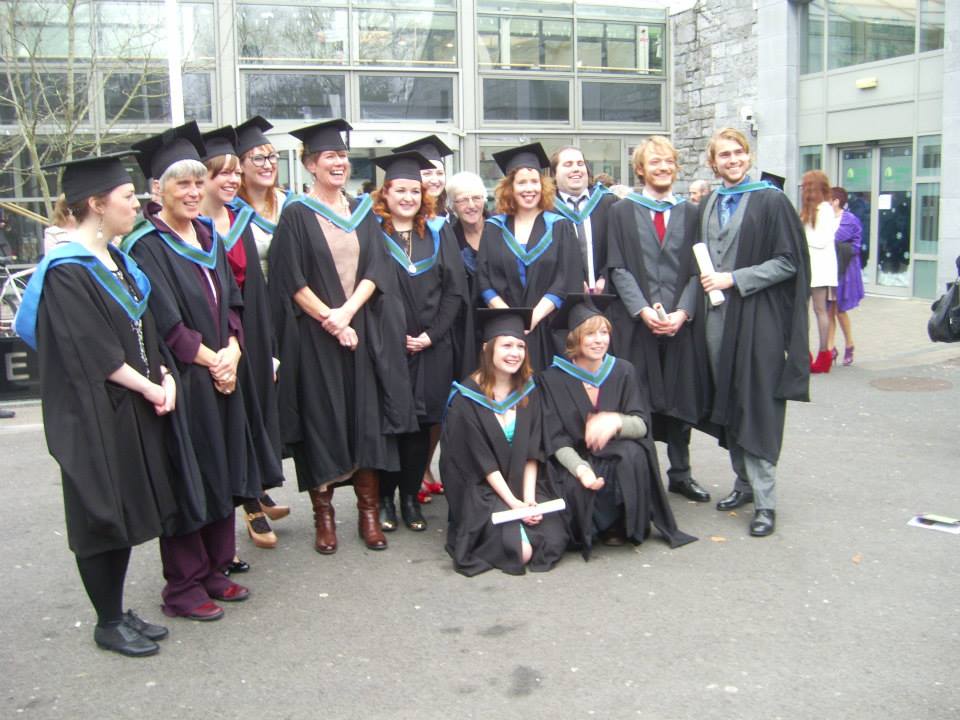
So, I have a job. This week I received an MA in Writing from NUI Galway. I was looking forward to the celebration: the family dinner, the donning of the cloak and mortar board, the few drinks. I hadn’t really considered the ‘value’ or ‘significance’ of the work I had done in the last year or what it meant. At the conferring ceremony, the Registrar and President referred to the long academic tradition, to the achievements of academia and the role played by universities in society…great pomp and circumstance. But, it was only after reading Doris Lessing this week that I really thought about the title of Writer that the MA in Writing has conferred upon me and that as such, I have responsibilities… so readers…be warned!

Seriously, it was a great week. The pomp, ceremony  and celebration did help me understand the importance of the Degree (although the parchment does not specify in what I have been conferred) and how it was an achievement.  It is too easy to shrug off such things. And Doris Lessing reminded me that how with such achievement comes responsibility. I do not have her skills or abilities, but a writer reflects his or her society for no person is an island, and therefore can help foster and share ideas and forge positive change.

Thank you to everyone who helped me through the year…whether with money, encouragement, love or acts of kindness. I hope, as readers, you do not live to regret it!

After the Grad, our MA class launched our anthology, The Adventure Hat which we produced as The Black Fort Writers. It is an eclectic mix of short stories, prose, poems, reviews and non fiction. Here are a few photographs.

Image

ImageImage

Standard

Plus ca change, plus c’est la meme chose?

I have been paying my respects to Doris Lessing this week and, in so doing, I have found for the first time in months a book that taunts, provokes and captures mood, attitude and life in exquisite detail and depth. It paints a picture, haunting and harrowing, of black and white life in the South African veldt. It is ‘Singing in the Grass’.  I first read Doris Lessing when I was 15. I am so glad to be reading something again that has a voice which is intelligent, astute and describes so explicitly, but with such subtlety, the strictures that society lays upon the individual. Of course Doris Lessing describes the horrors of apartheid, but the perils of inequality, injustice thrive in society still as shown in Philip Doherty’s Play, The Circus of Perseverance, which I went to see this week in Cavan. Philip picks up the same theme: the coping mechanisms of ordinary people living within structures and strictures imposed by society. The play is good: witty, colourful and frenetic, and it was brilliantly performed. Today the books and plays I read or see are different to Lessing’s writing. The shape is different. They reflect a more piecemeal approach to life, but also have a worldly tone which is cynical. Maybe this reflects the schism and conflict between globalisation and individual responsibility. But, I guess, maybe this schism has always been there between the state and the individual…now it’s just growing. Maybe now, it’s less of a schism and more of a growing, unwieldy amoeba with ever lengthening tentacles which I know is a contradiction in terms. Maybe that’s my point.

Also this week, I have been working on an interesting Peace III funded project, writing up the experience and learning of people from Fermanagh and Cavan who have been meeting and learning about each other’s experiences of the Troubles in the border region. It never fails to amaze me, however many books I read,  how difficult it is for people, every single one of us, to be truly at ease with difference, to live with people who have different views without feeling uncomfortable. In the past and still today, people go to war to defend beliefs structured and delineated by the society they live in, even if they are unsure that what they do is right (The German mini series, Generation War on RTE 2 at the moment is interesting in this respect). Forty years ago, The Grass Singing captured perfectly the delineations and veils society imposes on human nature. Today, The Circus of Perseverance shows the resilience of people left at the mercy of capitalist society. So this week I have been privileged to meet ordinary farmers and small business people in Cavan and Fermanagh prepared to challenge themselves, and their views by listening to each other and learning and in so doing look to alter our natural instinct to judge others according to our own familial and society’s values.

Standard

The Poetry Cafe at The Haggart

Wonders Never Cease!

I blogged recently about The Haggart in the depths of rural Longford when I went to see a monologue on the life of Oscar Wilde and got lost on the way. Actually, when you know the way, it’s very straightforward (Left at The Cross and Straight On Til You Get There, a bit like Never Never Land) and last night we sailed through a black, cold, starry sky straight to the door of the Poetry Cafe at The Haggart.

My last blog about the Haggart had inadvertently raised some hackles so when I met Michael Masterson (he who runs the venue) at the Mushroom Festival at Kilbracken House (itself worth a separate blog), we got talking…and talking…and talking. Anyway, the culmination of the chat was the Poetry Cafe at The Haggart last night.

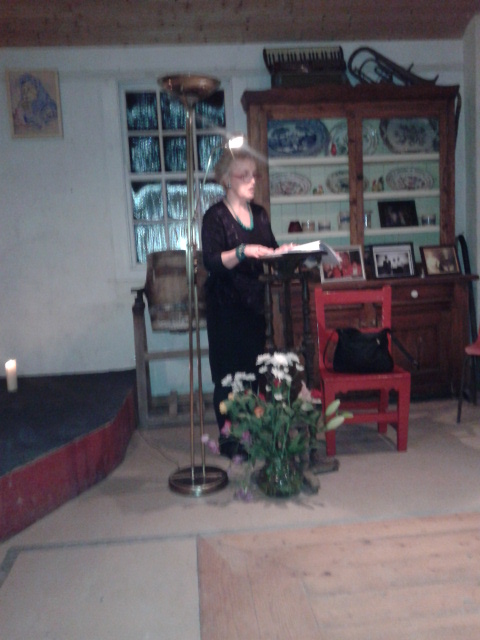
The Poetry Cafe at The Haggart was the first of what I hope might be many. I don’t know how quite to describe it. It looked lovely (thanks to Julie) furnished like a cafe, soft light, red and white tablecloths, flowers, candles, plates of cakes and biscuits and home made bread, tea or whatever beverage people brought with them. And what a fascinating collection of diverse poets from Longford, Leitrim and Cavan (The Haggart is where the three provinces meet)!

There were three key readers, and over nine local poets who recited to an audience of fifty plus, all of different hues and ages. We had ballads, sonnets, eulogies, personal reflections, some very lyrical, sharp, political, others more pedestrian. But isn’t that the glory of such an evening set in the heart of rural Ireland? A motley collection of characters reading their poetry to an eclectic assembly of folk! I hope this description doesn’t get me in trouble but I really liked the bizarre flavour of the whole event, which was perfectly MCd by Jim Williamson, a local historian and a real gentleman.

Photo is Angela McCabe from Ballinmore

 Image

Standard

I was in London this weekend reading Elizabeth Gilbert’s, The Signature of Things. I had read a review in the Irish Times which described the book as reflecting an interesting journey through the life of an American woman of science during the 19th century.

The book races through the life story of her father who through pure stamina and determination to pull himself up by his bootstraps after a poverty stricken childhood, travels the world, collects plant specimens and emigrates with a Dutch woman to Philadelphia to become the richest man in the State. I quite enjoyed the tales of his travels, though it was related in preamble to the introduction of Alma, the main protagonist, and so had a sense of simply providing the back story.

Alma is a chip off the old block and the rest of the book focuses on her journey through childhood and adolescence into womanhood and old age. The character is drawn well, but I found myself wondering, with suspicion, where all this was leading to. Alma is a botanist. She is a scientist. This is her journey of discovery into the nature of humanity, human emotion and spirituality. It discusses existentialism in a rather over stated way which I found irritating. I felt it was all rather obvious and I found the metaphysical explorations trite. There are nice character descriptions and some interesting character portrayals, but they serve only as satellites for Alma.

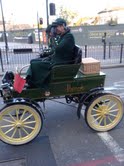
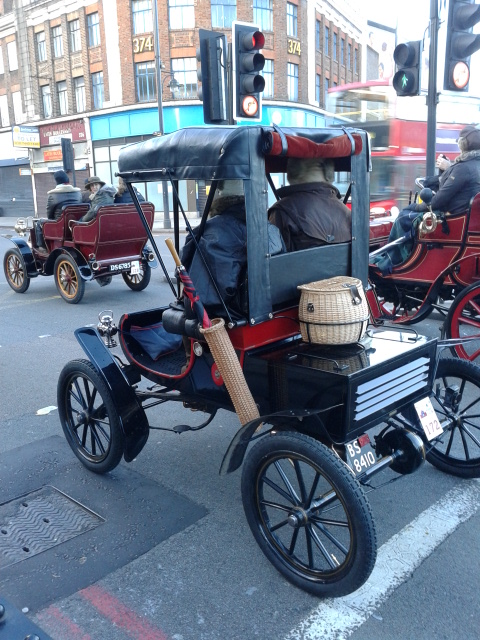
Much more enjoyable was getting up at dawn with my brother to go and watch the Classic Car Race through London to Brighton in the early morning light (it is extraordinary how many people are about at that time in the morning on a Sunday). All cars had to be over 100 years old. It was wonderful. We stood by the pedestrian lights on the Brixton Road and kept pressing the button so they had to stop and we could see them. (Sorry to those people who had to get out and start pushing or cranking to get going again). Polished paint and brass, fine wooden wheels, many had steering sticks as opposed to wheels and were open to the freezing wind. They trundled past bright red, sunshine yellow, brilliant blue, stately green with drivers and passengers all with woolly, and fur hats and scarves flowing.  I loved the wicker baskets stacked on the back, the brolly stands on the running boards, filled with colourful umbrellas. There was one running on steam with a man shovelling in the fuel. The headlights on another were flames encased in glass (presumably lit with paraffin). Today modern cars come equipped with coffee holders. One of my favourite cars had three glass and brass flasks of amber liquid with glass straws. Lovely. They made my day! That was truly spiritually up-lifting.

ImageImageImageImage

Aside

Sky Light

Sky Light

Bulgarian Rose applauds
broken turquoise.
Waves of sea green
roll through cloudy bone.
Flashes of blue bonnet
seep with bittersweet
in a dreamy drift of
florescent yellow.

Aubergine melts
in a storm of bubbles.
Chartreuse leaks
in cosmic latte
sprinkled with
congo pink
on cornsilk and
cyber grape.
Candy apple red
bleeds.

Charleston green
whispers with eerie black
biding time.

Standard

Down Under


            My last weekend definitely focused on ‘down under’. I went to the Aussie Rules football match in Cavan and gave up reading The Luminaries.

            The Luminaries, by Eleanor Catton is set in New Zealand during the Gold Rush. The first third focuses on the sudden death of a man and a disappearance of another. I say the first third because I am struggling with the book, and the fact that there are another 500 pages is a definite deterrent.

            I find the style of writing (which is of the period) restrictive. Maybe this would matter less if the plot moved a little quicker. The characters, of which there are many, are intricately drawn and I am impressed by the way she captures the different nuances and specifics of their natures.

            “Whenever he behaved badly or questionably, he simply jettisoned the memory and turned his mind to something else.”

            However, I began to feel that I am told everything rather than shown. While her characters are well drawn, I find myself not interested in them or lost because she moves too quickly on to another portrait. I don’t like not finishing books but, I don’t think I’ll finish this one.

            The Aussie Rules match was good. Although we were late, we found front row seats (they were a bit damp so were empty) and I had a great time waving flags and cheering the lads on. I was sitting next to a woman from Tyrone who loved her GAA. We couldn’t understand why the whistle kept blowing when the lads caught the ball. It seems that when there is a clean catch, the opposing marker has to take three steps back and gave the player space. It made the game far less aggressive. In the first two quarters, it was almost placid. An odd word to use in conjunction with GAA. However, the Aussies put their arse into it in the third quarter and made an exciting come back. Thank God, we still won.

            I don’t often go to matches. I loved being a part of that swarming wave of fans, a mass movement of arms, legs, and faces; to be a part of the thousands stamping away home in the night, streaming through the stadium gates, thronging along the Dublin Road to buses and cars. The Gards had stopped all the traffic in Cavan Town as far back as the N3 Roundabout and the wave flowed across the width of the night lit road outwards, across the white lines, the Give Ways, moving, moving, a rumble of power. It gave me a feeling of belonging and strength…

Standard

Eclectic Art in Cavan

Eclectic Art in Cavan

There is an eclectic exhibition at no. 61 College St, Cavan this weekend which is worth a visit. I love the line drawings by Sally O’Dowd. Most of them are drawn in one or two continuous lines but the sketches are very intricate. I love the idea that the pen has not come off the paper. Very clever.

Jane McCormick’s sick selfies series is grim, but powerful. She captures the sense of powerlessness and pain. I particularly like ‘silence’.

Mark Lawlor’s has a wolf theme going though his exhibits which are quirky and fun. Be warned there is cured hare’s head in a tin. His material amused me.

Pawel Kleszczewski’s pictures are scary. He has drawn 9 scenes from the bible using crayon and charcoal. They are dark but illuminating. I liked them immensely They’d look great in our hall.

Jackie O’Neil’s art is fascinating. She digitally prints an illustration on calico and then enhances aspects of the print with hand embroidery. They are subtle, almost whimsical but at the same time have a strong imprint. The embroidery, although delicate, gives them real depth. I loved the fish in a bowl, the giraffe, and the flamingos.

Finally, the last exhibit I saw was Kaisa Zimmoch though I think Siobhan Harton has an exhibit there but it wasn’t hung when I was there.  Kaisa has constructed a mushroom/toadstool fairy ring out of lidl brochures. You can stand in the middle of it and see what happens. It’s amazing what people do. So clever.

Most of the exhibits are for sale and are very reasonably priced. Great Christmas presents. 

Standard

Ordinary Life


Nothing to review in particular this last week. I was reading my story, Dead Mother’s Society (well, an excerpt) at The Over The Edge Fiction slam on Friday in Galway. I first this did this last year at the start of my MA in writing. It was a much more enjoyable experience this time round which, I think, reflects how much my writing and confidence has improved. Thank you NUI, Kevin and Susan. Kevin and Susan run Over The Edge in Galway. Every month they have readings and open mics and more. They provide a great artistic outlet. If in Galway, go.

I’m also really enjoying the poetry workshop I facilitate in Cavan on Tuesday evenings. It’s a great group of poets who give each other much sustenance and support. Maybe next year I can follow Over The Edge’s lead and we can start a monthly reading and open mic in Cavan. There’s great talent in the county.

And, I want to mention Parov Stelar. This is a brilliant electric swing musician to whom I listen and dance to every day. I walk and dance The Bog Road every day. This morning I felt like the rabbit without the Duracell batteries – totally out of puff. Parov Stelar got my feet twitching, my arms flowing, my hips and shoulders rhyming and my spirit smiling again. His two albums (are they called that still?) are Coco and Princess. Check him out.

Standard